Epa Literature Review of Livestock and Poultry Measures
Environmental Impacts of Farthermost Animal Confinement
Beast agronomics has changed dramatically in recent decades. From the practice of concentrated brute solitude on manufacturing plant farms to the massive land use required to produce feed crops for livestock and the pollution inherent in poorly regulated waste management and slaughterhouses, the current U.S. food system is unsustainable and a leading correspondent to environmental deposition.
Most of the 9 billion farmed animals in the United States are confined in concentrated animal feeding operations (CAFOs), which churn out meat, poultry, egg and dairy products at an unmanageable charge per unit. The almost extreme solitude practices — battery cages, gestation crates and veal crates — have been outlawed in a dozen states. Yet they largely continue as standard practices and are linked with poor animal welfare, risks to nutrient and worker safety, air and water pollution, greenhouse gas emissions and threats to endangered species.
The Rise of Concentrated Brute Feeding Operations (CAFOs)
Since the 1950s U.South. meat and dairy production has more than than doubled, while the number of operations has decreased by 80 percent [1]. As a result greenhouse gas emissions from the agricultural sector have rapidly increased, with carbon dioxide emissions increasing by 16.ii percent, methane emissions past fourteen.4 percent and nitrous oxide by vii.3 pct in the past 30 years [2]. Marsh gas and nitrous oxide have as much equally 36 and 298 times greater global warming potential, respectively, of CO2 over a 100-twelvemonth period [3].
The most common environmental threats from these facilities include:
- Contamination of air, water, and land from nutrients, pathogens, heavy metals, pharmaceuticals, and ammonia;
- Overconsumption of groundwater resources;
- Harm to endangered or threatened species and habitats;
- Release of greenhouse gas emissions [4].
Forth with the rise of CAFOs, emissions related to manure direction have increased by 66 percent since 1990 [5]. Manufactory farms produced an estimated 13 times equally much waste every bit the entire U.S. population in 2012 [6]. Unlike human being waste matter, livestock waste material is typically untreated and poorly managed.
The EPA estimates that pollution from CAFOs impairs 40 percent of rivers and streams in the United States [7].
Pigs and Gestation Crates
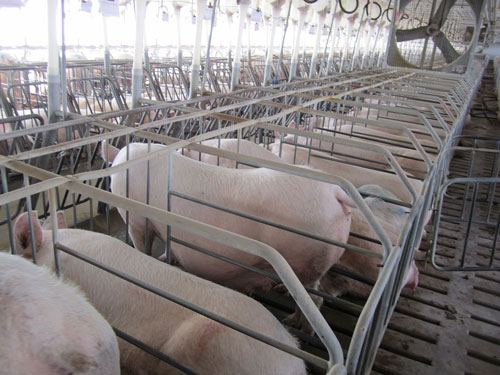
- With more than 70 million pigs populating the United states of america, and 5.36 one thousand thousand breeding sows, factory farms have implemented the practices of extreme confinement of female parent pigs in gestation crates. These tight stalls prevent sows from turning around and comprise no bedding, just slatted floor for waste disposal.
- In 2014, 93 percent of annual hog production was on operations with at least 5,000 caput (compared to 27 percent in 1994) [8]. This shift toward more concentrated facilities has resulted in increases in water and air contamination and environmental impairment [ix].
- The increased concentration of hogs and breeding sows creates huge cesspools of waste product that are currently disposed of by spraying onto surrounding lands. The massive amounts of waste generated in limited geographic areas leads to intensive air and water pollution and related health risks to surrounding communities and wild fauna.
- For example, in Iowa, more than x billion gallons of liquid manure are applied to fields per twelvemonth from the state'south more than than 6,300 pig operations [x]. State records bear witness 800 manure spills betwixt 1996 and 2012, and 750 out of 1,378 tested waterways were establish to exist dumb [11].
Chickens and Bombardment Cages
- Most chickens spend their entire lives stocked in "battery cages," in such high densities that they cannot exert their natural behaviors of nesting, roosting or fifty-fifty flapping their wings. Many chickens will die from disease and stress related to overcrowded conditions. However, the concentration of factory farming continues to encourage the utilise of these facilities.
- The production of poultry has shifted over recent decades toward more concentrated facilities [12]. The production of eggs has seen a related boom: Since 2011 tiptop states have produced an additional 11.two billion eggs in CAFO operations, including California, Ohio, Indiana, Missouri, Michigan, North Carolina and Texas [13]. The number of egg-laying hens increased by nearly 25 per centum betwixt 1997 and 2012, and the size of egg operations has grown by nearly 75 percent since 1997 [14].
- Battery cage facilities produce loftier levels of air contagion from ammonia and hydrogen sulfide as well as volatile organic compounds and dust originating from craven feathers, bedding and craven manure. Pollutants spread from the chicken cages and fields to waterways, critical habitat areas, and local community houses, churches and schools.
- In addition to large amounts of pesticide and pharmaceutical residues, bacteria, viruses, pathogens, parasites, protozoa, heavy metals and other trace elements [15], poultry waste product is specially high in toxic nutrients, and nevertheless is usually untreated, and stored and land-practical [16,17]. Over ninety percent of poultry waste matter is disposed of through land applications [18]. Erosion, non-agronomic waste applications, and rain can cause information technology to reach surface and groundwaters [19].
- Release of these pollutants may outcome from intentional belch, functioning, maintenance, management and/or operation design problems [20]. Waste material-management systems can have spills, leaks, adventitious discharges and attain surface water and/or groundwater [21].
- The EPA has noted that pelting falling on dry poultry manure left exterior uncovered will likely transport pollutants into nearby soil, causing groundwater pollution and contaminating surface waters [22].
Calves and Veal Crates
- Calves are removed from their mothers to forbid suckling and chained in crates — 22 inches by 54 inches — without the ability to move or turn around. Preventing the animals from moving keeps their muscles bloodless, and the calves are fed formula instead of mother'south milk.
- Calf waste is distributed either through deep pit storage or flush. The floor of the crate is composed of slats straight above a storage pit or flush alley. This flooring does not adequately allow feces and urine to pass through, and animals end up standing and sleeping in their own carrion, leading to the wrinkle of parasites, a virus or harmful bacteria. Diarrhea from dehydration is common and sometimes fatal [23].
- The majority of veal operations use large volumes of water to affluent manure from storage pits to lagoons. The remaining operations store manure in a large pit below the shed, which uses less water but results in a higher concentration of nutrients.
- Calves are slaughtered betwixt four to 5 months of historic period. Merely calves younger than 4 months are not included in greenhouse gas emission estimates, and then the climate touch of veal production is unaccounted for [24].
Lack of Environmental Protection
Despite 40 years of Make clean Water Act implementation, the EPA nonetheless lacks data about where the nation'south CAFOs are located and which facilities discharge pollutants into waterways without required permits [25].
The EPA states 40 percentage of CAFOs are regulated under National Pollutant Discharge Elimination Systems (NPDES) while 75 pct discharge every bit a result of "standard operational profiles" [26].
Despite major gaps in information and regulation, the EPA abased its only effort in decades to fill up these gaps by developing a national inventory, under CAFO industry pressure level [27]. This failure by EPA to develop or maintain a CAFO inventory has meant that states must identify CAFOs and determine which are bailiwick to regulation with petty guidance or oversight from EPA.
The lack of federal oversight leaves communities bearing the burden of the environmental impacts of industrial livestock production. Lawmakers can take steps to protect air, water and wild fauna by banning the most extreme forms of confinement and working to close regulatory loopholes at the country and federal levels.
References
[1] APHIS, USDA. Overview of U.S. Livestock, Poultry and Aquaculture Production in 2015. https://www.aphis.usda.gov/animal_health/nahms/downloads/Demographics2015.pdf
[2] EPA, Draft Inventory of U.Due south. Greenhouse Gas Emissions and Sinks 1990-2017. https://www.epa.gov/ghgemissions/typhoon-inventory-u.s.-greenhouse-gas-emissions-and-sinks-1990-2017
[3] EPA, Understanding Global Warming Potentials. https://world wide web.epa.gov/ghgemissions/understanding-global-warming-potentials. Accessed iv/3/2019.
[iv] EPA Literature Review, at 1-iii.
[5] EPA, Draft Inventory of U.Southward. Greenhouse Gas Emissions and Sinks 1990-2017. https://world wide web.epa.gov/ghgemissions/typhoon-inventory-u.s.-greenhouse-gas-emissions-and-sinks-1990-2017
[half-dozen] EPA, National Pollutant Discharge Emptying Organisation (NPDES) Concentrated Animal Feeding Operation (CAFO) Reporting Dominion, Proposed Rule, 76 Fed. Reg. 65431, 65433 (Oct. 21, 2011); Food & H2o Scout, Mill Farm Nation 2015 Edition three (2015), http://www.foodandwaterwatch.org/sites/default/files/factory-farm-nation-written report-may-2015.pdf.
[7] EPA, 2000 National Water Quality Inventory Report to Congress. https://www.epa.gov/waterdata/national-water-quality-inventory-report-congress
[viii] Overview of the U.s. Squealer Industry, released Oct 29, 2015 by the National Agricultural Statistics Service (NASS), Agricultural Statistics Board, USDA http://usda.mannlib.cornell.edu/usda/current/hogview/hogview-10-29-2015.pdf.
[9] Pew Committee on Industrial Farm Animal Production, "Putting Meat on the Tabular array: Industrial Farm Brute Production in America" (2008), http://www.pcifapia.org/_images/PCIFAPFin.pdf.
[10] Brian Bienkowski, "My number one concern is h2o," Environmental Wellness News (Nov. 14, 2017), http://www.ehn.org/water-pollution-grunter-farming-2504466831.html.
[11] Id.
[12] See by and large Pew Charitable Trusts, The Business of Broilers (2013), bachelor at http://world wide web.pewtrusts.org/~/media/legacy/uploadedfiles/peg/publications/study/businessofbroilersreportthepewcharitabletrustspdf.pdf [hereinafter The Concern of Broilers]; U.S. Environmental Protection Agency (EPA), Literature Review of Livestock and Poultry Manure, EPA 820-R-xiii-002, 1 (July 2013).
[xiii] USDA, National Agricultural Statistics Service. 2018. https://quickstats.nass.usda.gov/
[14] Food and Water Watch. Mill Farm Nation: 2015 Edition. https://www.foodandwaterwatch.org/insight/factory-farm-nation-2015-edition
[15] Exhibit 7 - EPA, Detecting and Mitigating the Environmental Impacts of Fecal Pathogens Originating from Confined Creature Feeding operations: Review, EPA/600/R-06/021, ane-3 (Sept. 2005) (citations omitted); see likewise Exhibit iv - 68 Fed. Reg. at 7235-36.
[16] Exhibit 47 - J.A. Stingone & S. Wing, Poultry litter incineration as a source of energy: reviewing the potential for impacts on environmental health and justice, ane(1) NEW SOLUTIONS 27-47, 33 (2011) (referencing International Agency for Research on Cancer, Monographs on the Evaluation of Carcinogenic Risks to Humans: Some Drinking Water Disinfectants and Contaminants, Including Arsenic (2004); Exhibit 48 - M. Vahter, Health effects of early life exposure to arsenic, 102 Bones & CLINICAL PHARMACOLOGY & TOXICOLOGY 204-211 (2008); Exhibit 49 - C.D. Kozul et al., Depression-dose arsenic compromises the immune response to influenza A infection in vivo, 117 Ecology Wellness PERSPECTIVES 1441-1447 (2009).
[17] Exhibit 4 – EPA 2003 Final Rule at 7235-36.
[18] Exhibit 55 - PEW Commission ON Farm Brute PRODUCTION, ANTIMICROBIAL RESISTANCE AND Homo Wellness 31 (2008) (citations to USDA resources omitted.)
[19] See, east.g., Showroom 8 - NRCS AWMFH Ch. 3 "Agronomical Wastes and Water, Air, and Beast Resource"; Exhibit 56 - NRCS Conservation Practice Standard Code 590 "Nutrient Management" (Jan. 2012).
[xx] Run across, e.g., Showroom 51 to 54 - NRCS AWMFH Ch. 2 (Planning Considerations) (Showroom 51); Ch. 7 (Geologic and Groundwater Considerations) (Exhibit 52); Ch. 8 (Siting Agricultural Waste matter Management Systems) (Exhibit 53); Ch. 9 (Agricultural Waste product Direction Systems) (Showroom 54).
[22] Id. NRCS AWMFs specifically advise producers plan for such considerations.
[23] Exhibit 4 – EPA 2003 Final Rule at 7192; see likewise Exhibit 8 - AWMFH Ch. three (Agronomical Wastes and Water, Air, and Brute Resources) at 3-17 (discussing pathways to pollution); Exhibit 56 - NRCS AWMFH Ch. 9 (Agricultural Waste matter Direction Systems) at ix-23.
[24] EPA, "Non-water Quality Impact Estimates for Animal Feeding Operations." (December 2002).
[25] EPA, Typhoon Inventory of U.South. Greenhouse Gas Emissions and Sinks 1990-2017. https://world wide web.epa.gov/ghgemissions/draft-inventory-the states-greenhouse-gas-emissions-and-sinks-1990-2017
[26] Proposed CAFO Reporting Rule, 76 Fed. Reg. at 65436.
[27] National Pollutant Discharge Elimination System (NPDES) Concentrated Animal Feeding Performance (CAFO) Reporting Rule, Withdrawal, 77 Fed. Reg. 42679 (Jul. 20, 2012).
Source: https://www.biologicaldiversity.org/takeextinctionoffyourplate/factory_farms/index.html
0 Response to "Epa Literature Review of Livestock and Poultry Measures"
Post a Comment